
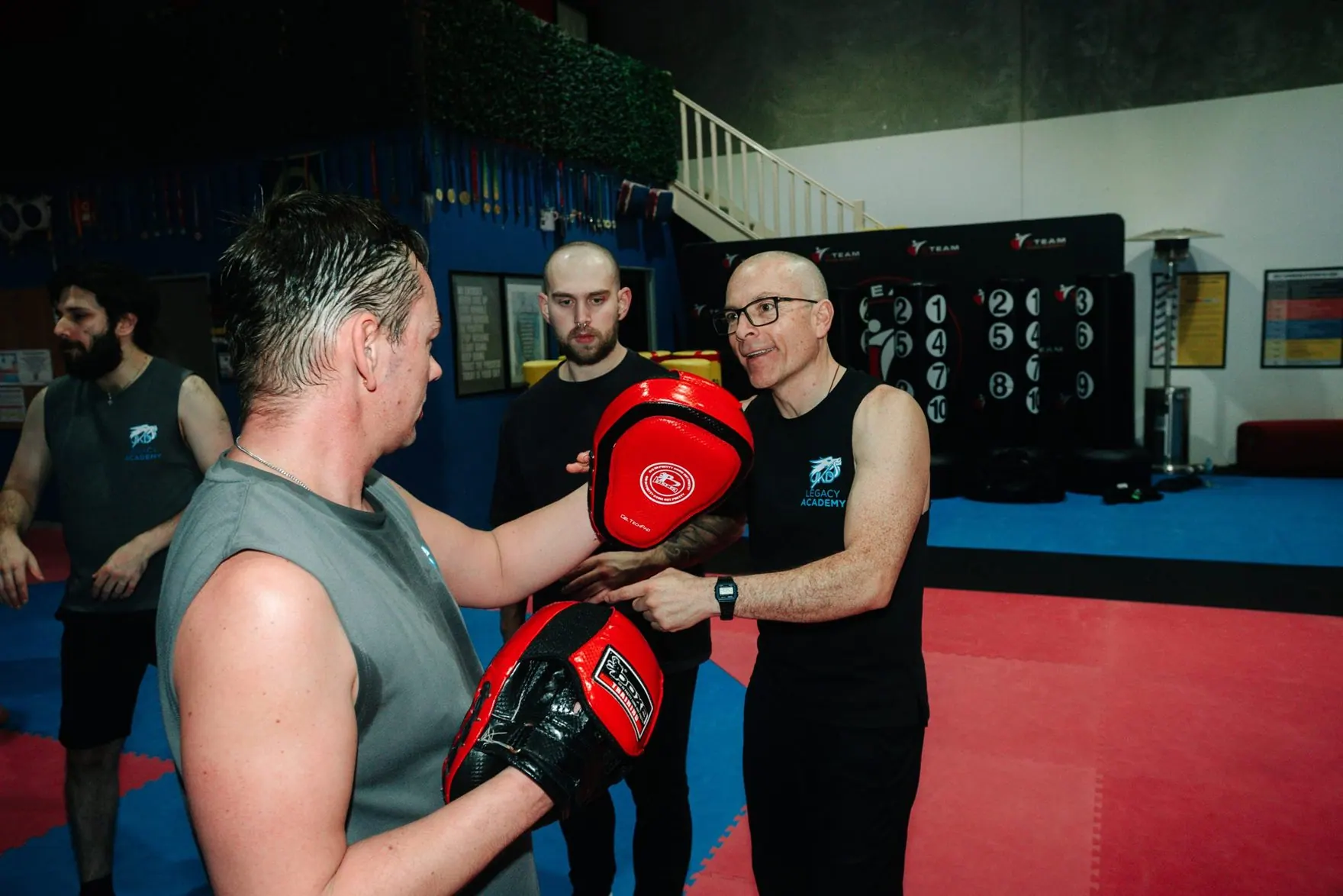
Jeet Kune Do can be effective in a real fight when it is trained against resisting partners, not only in pre-arranged drills. Its strengths are interception, simple direct techniques, lead-side striking, footwork and moving between kicking, punching, trapping and grappling ranges. Real self-defence still starts with awareness and avoidance; physical technique is the last resort.
Ask ten martial artists whether Jeet Kune Do works in a real fight and you will get ten answers, most of them louder than they are useful. The honest answer is less dramatic: JKD can be very effective for self-defence, but only when it is trained against resisting partners and built on solid fundamentals. The name on the door matters far less than how the class actually trains.
Is Jeet Kune Do effective in a real fight?
Yes, Jeet Kune Do can be effective in a real fight when it is trained "alive": against a partner who moves, resists and responds, under supervision, rather than only in pre-arranged drills. Its core ideas (intercepting an attack, keeping techniques simple and direct, and moving freely between kicking, punching, trapping and grappling ranges) hold up well under pressure. What fails is any martial art practised only as choreography.
That is not a JKD problem; it applies equally to karate, kung fu, Krav Maga or anything else. A technique you have only ever done on a cooperative partner is a hypothesis. A technique you have done against someone genuinely trying to stop you is a skill.
Why does how you train matter more than the style?
Because fighting is a skill of timing and judgement, and those only develop when your partner is unpredictable. Drills are essential for learning the shape of a movement, but if training never progresses beyond them, students tend to freeze or flail the first time someone does something unexpected. Good JKD instruction adds pressure in stages:
| Training approach | What it builds | Where it falls short |
|---|---|---|
| Solo drills and shadow work | Mechanics, balance, footwork patterns | No timing against a real person |
| Cooperative partner drills | Distance, targeting, coordination | The partner is predictable |
| Drills with progressive resistance | Reading intent, adapting, staying calm | Still limited in scope |
| Supervised sparring | Timing, composure, honest feedback on what works | Needs a solid foundation and careful coaching to stay safe |
Bruce Lee himself was openly critical of training that looked impressive but could not survive contact. His emphasis on sparring with protective equipment, and on testing ideas for yourself instead of accepting them on faith, is one reason JKD is still taken seriously today.
What is Jeet Kune Do actually good at?
JKD's strengths come from its central idea, interception, and from Bruce Lee's insistence on economy of motion. If you are new to the art, our guide to what Jeet Kune Do is covers the background. For effectiveness, these are the qualities that matter:
- Interception. Jeet Kune Do means "the way of the intercepting fist". Rather than block and then counter, you aim to meet the opponent as they commit to their attack, with stop-hits and stop-kicks.
- Simplicity. A small number of direct techniques you can actually perform under stress, rather than a long catalogue you will never recall when adrenaline hits.
- Lead-side striking. JKD places the strong side forward, so the closest weapons, such as the straight lead punch and the low side kick, are also the fastest and most accurate.
- Footwork. Influenced by boxing and fencing, JKD footwork controls distance, so you decide when contact happens, or whether it happens at all.
- Combining ranges. Kicking, punching, trapping and grappling are trained as one continuous fight rather than as separate arts, which is much closer to how real confrontations unfold.
- A framework for attacking. The five ways of attack give students a clear method for creating openings instead of throwing techniques and hoping.
What are the common criticisms of JKD, and are they fair?
Some of them are fair, and a credible school should answer them directly rather than wave them away.
"JKD is just a philosophy, not a fighting system"
Partly true, and partly a misunderstanding. Bruce Lee described JKD in terms of principles rather than a fixed style, but those principles sit on a concrete technical base: the on-guard position, footwork, the straight lead, kicking, trapping and grappling. Philosophy without that base is just talk, and the base without the philosophy becomes another rigid style. Effective JKD needs both.
"Everyone does their own thing"
This is the most valid criticism. Lee's advice to absorb what is useful and discard what is useless has sometimes been read as permission to skip the fundamentals and call any mix of techniques "JKD". Since his death, instructors have also taken the art in different directions, which is why you will hear terms such as "original" JKD and JKD "concepts". For a prospective student, that creates real confusion about what is actually being taught.
The fair answer is lineage and transparency. Personal expression is meant to come after the fundamentals, not instead of them, and the fundamentals are best learned from someone who received them first-hand. At Jeet Kune Do Legacy Academy, Sigung Ricardo Vargas was personally trained and certified by Sifu Jerry Poteet and Sigung Richard Bustillo, both direct students of Bruce Lee, so what is taught can be traced back to its source. You can read about that chain of instruction on our lineage page. Whatever school you consider, ask who taught the instructor and whether their certification can be verified.
"Trapping doesn't work against a resisting opponent"
Long, cooperative trapping sequences rarely survive a real exchange, and honest instructors say so. In practice, trapping shows up in brief moments: when arms collide, in the clinch, or as you close distance to strike. Trained through sensitivity drills with gradually increasing resistance, it teaches you to feel and use an opponent's energy at close range. It is one tool among several, not the whole art.
Did Jeet Kune Do lead to mixed martial arts?
Not directly, but Bruce Lee is often described as a forerunner of modern mixed martial arts. Long before MMA became a sport, he argued that a complete fighter should be able to kick, punch, trap and grapple, and that no single style held all the answers. MMA grew through its own competitions and athletes, yet the idea of training across every range and keeping only what works is very much in the spirit of JKD.
Is JKD good for street self-defence?
JKD's physical skills transfer well to self-defence, but real self-defence starts long before anyone throws a punch. Awareness, avoidance and de-escalation will protect you far more often than any technique. Noticing trouble early, keeping your distance, using your voice and walking away are all wins.
When a physical response truly cannot be avoided, JKD's emphasis on simple, direct actions, on interception and on creating a chance to get to safety (rather than "winning") suits the situation well. In Australia, any force used in self-defence generally needs to be reasonable in the circumstances; we cannot give legal advice, but a responsible instructor will discuss the principle in general terms. And no martial art can guarantee your safety. For a wider comparison of styles, read the best martial art for self-defence, or see our self-defence classes in Melbourne.
How does Jeet Kune Do Legacy Academy train?
We build skill in layers, so pressure is added only when you are ready for it:
- Beginners start in Foundation, a 12-week rotating program covering the philosophy of interception, guard and stance, footwork, the straight lead, striking, kicking and an introduction to trapping.
- The Progression level adds Jun Fan kickboxing, the wooden dummy (mook jong), grappling and clinch work, the five ways of attack, energy drills (chi sao) and sparring methods.
- Sparring is introduced only at intermediate and advanced level, is always supervised by the instructor and is never compulsory.
- Classes are small, and every session includes personal corrections from Sigung Vargas or one of our certified instructors.
The full curriculum, timetable and prices are on The Way.
Key takeaway: JKD is as effective as the training behind it. Look for verifiable lineage, solid fundamentals and a clear, safe path from drills to supervised sparring.
Try a class in Melbourne
The best way to judge JKD is to feel it for yourself. Leave your details on our free trial page and Sigung Vargas will call you within 24 hours for a short chat; your first class is free. Group classes run at our Maidstone headquarters on Tuesday and Thursday at 7 pm and Saturday at 9:30 am. In South Australia, an affiliated school in our lineage runs JKD classes in Adelaide.