
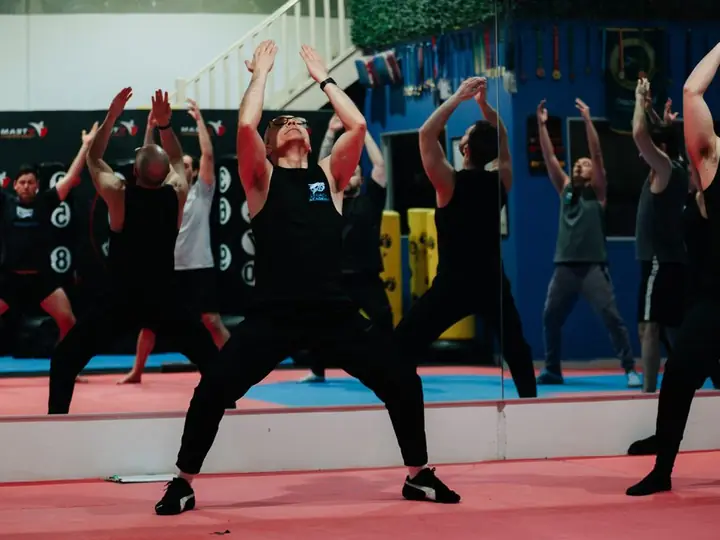
There is no single best martial art for self-defence. The best choice trains against resisting partners, covers striking, clinch and ground ranges, keeps techniques simple under stress, is taught by a qualified instructor and is one you can attend regularly, all built on awareness, avoidance and de-escalation first.
It is one of the most common questions anyone who teaches martial arts hears, and most people are hoping for a one-word answer. The honest answer is that there is no single best martial art for self-defence. There are arts that train in ways that transfer well to real situations, and there are schools that teach those arts well or badly. This guide sets out the criteria that actually matter, compares six popular options fairly and explains where Jeet Kune Do fits. It is written by a Jeet Kune Do school, so we will be upfront about JKD's limitations as well as its strengths.
Is there one best martial art for self-defence?
No. The best martial art for self-defence is one that trains you against real resistance, covers the ranges a confrontation can move through, and that you will actually keep practising. A street confrontation is a different problem from a sport contest: there is no referee, no weight class and no warm-up. There may be more than one person, a weapon, hard ground, alcohol or a cramped space. Every art handles some of those problems better than others.
So a more useful question is: what should a martial art give me if my main goal is self-defence?
What makes a martial art good for self-defence?
Six criteria matter more than the name of the style:
- Pressure testing. Techniques have to be tried against a partner who resists, introduced gradually and safely. Drills that only work on a compliant partner give false confidence.
- Realistic ranges. Confrontations can move from talking distance to strikes, to a clinch, to the ground. You need at least basic competence in each, and above all the ability to get back to your feet and leave.
- Simplicity under stress. Under adrenaline, fine motor control and complex decision-making tend to deteriorate. A small set of simple, well-drilled responses beats a large catalogue of techniques you have practised only a handful of times.
- Ability to train regularly. Location, timetable, cost, injury risk and enjoyment decide whether you are still training in a year. Consistent training in a good-enough art beats occasional training in the perfect one.
- Instructor quality. Look for verifiable qualifications, safe and structured classes, personal correction and an instructor who is honest about what their art does not cover.
- Legal and avoidance awareness. Good self-defence teaching covers awareness, avoidance, de-escalation and the idea of reasonable force, not only physical technique.
Why do awareness, avoidance and de-escalation come first?
Because the safest fight is the one that never happens. Physical skills are the last line of defence, not the first, and most of what keeps people safe is unglamorous:
- Awareness: noticing your surroundings, the people in them and your exits, and keeping your phone in your pocket when a place feels wrong.
- Avoidance: trusting your instincts, crossing the street, leaving early and choosing well-lit routes.
- De-escalation: a calm voice, open hands, keeping your distance and letting go of ego. Property can be replaced, and walking away is a win.
- Escape: if you have to act physically, the goal is to create an opening, get away and call 000, not to win a fight.
The law matters too. In general terms, Australian law allows people to defend themselves with force that is reasonable in the circumstances as they perceived them, and force beyond that can itself become an offence. The rules differ between states and territories and every situation is judged on its own facts, so treat this as general information, not legal advice.
How do the main martial arts compare for self-defence?
Here is a fair summary of six arts people commonly consider. Each of them can be taught well or badly, so use the table as a starting point for visiting schools rather than a verdict.
| Martial art | Strengths | Limitations | Best for |
|---|---|---|---|
| Krav Maga | Designed for self-defence rather than sport; simple, decisive responses; trains scenarios such as grabs, multiple attackers and weapon threats | Quality varies widely between schools; some rely on compliant drills with little live sparring; striking and grappling depth depends on the school | People who want a scenario-focused program and learn well through high-intensity drills |
| Brazilian Jiu-Jitsu | Live resistance (rolling) in almost every class; teaches a smaller person to control and escape from a larger one on the ground; builds calm under pressure | Going to the ground is risky with multiple attackers, weapons or hard surfaces; sport-focused gyms may not train strikes or self-defence scenarios | Anyone who enjoys problem-solving through live grappling and wants strong control and escapes |
| Muay Thai | Proven stand-up striking with punches, kicks, knees and elbows; strong clinch; hard pad work and sparring build conditioning | Little ground work; sport rules shape some habits; training is physically demanding | Fit, motivated people who want powerful striking and toughness |
| Boxing | Simple, high-percentage punches; excellent footwork, head movement and timing; sparring is routine; a fast route to functional striking | No kicks, limited clinch work and no ground; bare-knuckle punches carry a higher risk of hand injury than gloved ones | Anyone wanting an accessible, efficient striking base |
| Wing Chun | Close-range economy, centreline structure and simultaneous defence and attack; chi sao develops sensitivity at contact range | The amount of live sparring varies a lot by school; traditional curricula put less emphasis on long-range kicking and ground work | People who enjoy a traditional system and close-range skill |
| Jeet Kune Do | Blends kicking, punching, trapping and grappling ranges; interception and lead-side efficiency; trains adaptability rather than set patterns | The name is used loosely, so quality varies; the broad curriculum takes time; not a competition sport, so testing depends on the school's sparring methods | People who want one adaptable method across all ranges, with a philosophy behind it |
Notice a pattern: most limitations come down to ranges an art does not train, or schools that do not pressure-test. That is why many experienced martial artists cross-train, and why Bruce Lee designed Jeet Kune Do to work across ranges in the first place.
The best martial art for self-defence is one that is pressure tested, covers more than one range, keeps things simple, is taught by a qualified instructor and fits your life well enough that you keep training.
Where does Jeet Kune Do fit?
Jeet Kune Do's angle is adaptability. Bruce Lee built it to deal with whatever happens rather than a set scenario, drawing on Wing Chun, boxing, fencing and grappling. In practice that means:
- Interception: hitting an attacker as they commit, often with the lead hand or a low-line stop kick, rather than waiting to block.
- Combining ranges: training kicking, punching, trapping and grappling, and especially the transitions between them.
- Efficiency: direct, non-telegraphed tools such as the straight lead, chosen because they hold up under stress.
- Adaptability: principles and drills rather than fixed forms, so responses fit the situation and the person.
JKD has honest limitations too. Because the name is used loosely, teaching quality varies a great deal, and a broad curriculum takes time. Because it is not a competition sport, how well it is tested depends on each school's sparring methods. Check the lineage, ask how students train against resistance and watch a class before committing. We go deeper in is Jeet Kune Do effective?
At Jeet Kune Do Legacy Academy in Melbourne, head instructor Sigung Ricardo Vargas is a second-generation JKD instructor, trained and certified by Sifu Jerry Poteet and Sigung Richard Bustillo, both direct students of Bruce Lee. Students build stance, footwork, the straight lead, striking, kicking and an introduction to trapping in the Foundation program, then progress to Jun Fan kickboxing, grappling and clinch, energy drills and sparring methods. Sparring happens at intermediate and advanced level, is always supervised and is never compulsory. As Sigung Vargas says:
"A technique can teach you how to strike, but only sincere practice can teach you when to act, the humility to keep learning, and the character to use your strength wisely."
So which martial art should I choose?
Choose the art whose strengths match your goals, then choose the best school of that art you can get to regularly:
- If you want live grappling and ground control from day one, try Brazilian Jiu-Jitsu.
- If you want hard stand-up striking and conditioning, try Muay Thai or boxing.
- If you want scenario-based self-defence drills, look for a well-run Krav Maga school.
- If you love a traditional system and close-range skill, consider Wing Chun.
- If you want one adaptable method that blends ranges and teaches you to think under pressure, try Jeet Kune Do.
Before you sign up anywhere, take a trial class and ask questions. Our guide on how to choose self-defence classes in Melbourne includes a checklist. If you are a woman looking for practical options, see our page on women's self-defence in Melbourne, where you can also register your interest in a planned women's self-defence workshop.
Try a class in Melbourne
If Jeet Kune Do sounds like the right fit, the best way to find out is to train. Jeet Kune Do Legacy Academy runs self-defence classes in Melbourne at Unit 6 / 72-80 Hampstead Rd, Maidstone, on Tuesday and Thursday at 7:00 pm and Saturday at 9:30 am, for teens from 14 and adults. Leave your details on the free trial page, Sigung Vargas will call you within 24 hours, and your first class is free. In South Australia, Sifu Peter Pitrakkos runs an affiliated, independent school offering Jeet Kune Do and self-defence in Adelaide.