
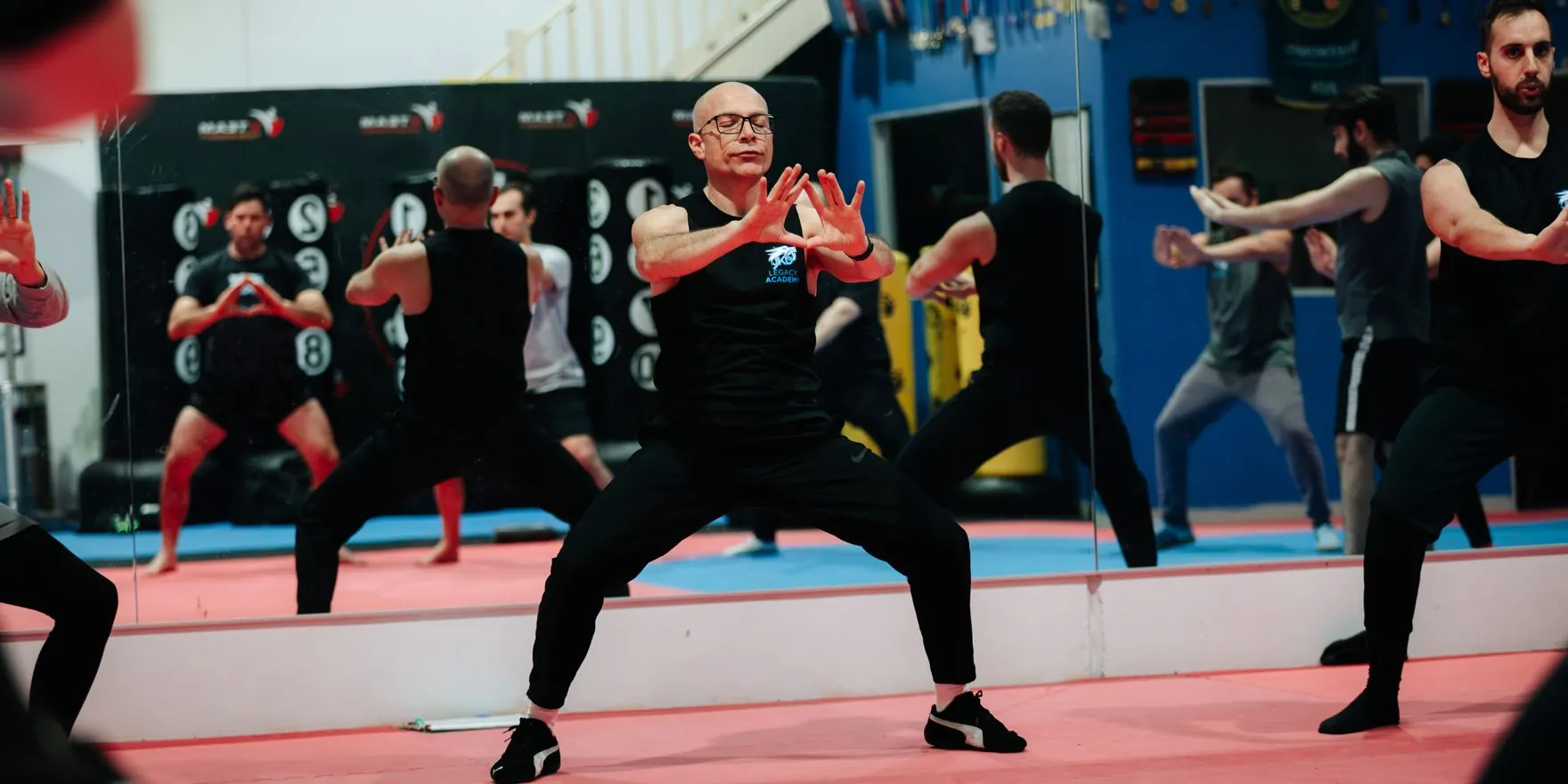
Self-defence for women works best in layers: awareness and avoidance first, clear boundaries and verbal de-escalation next, then a few simple physical skills such as palm strikes, elbows, knees, escaping grabs and getting back to your feet, all aimed at creating distance and getting away. Regular training builds these far more reliably than a one-off seminar.
Search for self-defence for women and you'll find everything from gadget adverts to viral videos of complicated wrist locks. Most of it misses the point. The skills that hold up in real life are less dramatic: noticing trouble early, saying no clearly, hitting with big simple movements when you have to, breaking free and getting away. This guide walks through each layer and what to look for in a class.
What actually works in self-defence for women?
What works is a layered approach: awareness and avoidance first, clear boundaries and verbal de-escalation second, and only then a small set of physical skills. Those skills are gross-motor strikes, escapes from grabs, getting up off the ground and creating distance so you can leave. None of them rely on size or strength, and all of them improve with regular practice.
Notice that "win the fight" isn't on the list. The aim of self-defence is to get home safely. Every technique should serve that aim.
Why do awareness and boundaries come first?
Awareness comes first because the situation you avoid is the one you never have to fight your way out of. That doesn't mean living on alert. It means relaxed attention: phone away when you walk to the car at night, noticing who is around you on a quiet platform, and trusting the feeling that something is off.
It also helps to remember that a lot of unwanted behaviour towards women comes from someone they know, such as a date, a colleague or an acquaintance at a party, rather than a stranger in a dark lane. That's why boundaries matter as much as blocks. Practising how to say no firmly, how to end a conversation and how to refuse to be moved somewhere more private is genuine self-defence training.
- Plan your exits. Know how you'll get home before you go out, and where the nearest busy, well-lit place is.
- Keep your hands free when you're moving through places that feel uncertain.
- Take early warning signs seriously: someone ignoring a small "no", closing distance, or trying to get you alone.
- Resist being moved. If someone tries to take you to a second, more isolated place, that's the moment to make noise and fight to stay where people are.
How do you de-escalate a situation with words?
You de-escalate by staying calm, keeping distance and giving the other person a way out, while making your boundary unmistakable. Short, loud, clear phrases work better than explanations: "Stop. Back off." or "I don't want to talk. Leave me alone." Say them with a firm voice, eye contact and your hands up in front of you, palms open.
That open-hand "fence" looks non-aggressive to bystanders, but it also puts your hands between you and the other person, ready to protect your head or push away. Volume attracts attention, which many people looking for an easy target don't want. If someone keeps closing in after a clear warning, you've learnt something important about their intentions.
Which strikes work best under stress?
The strikes that work under stress are simple, gross-motor movements that need no fine coordination: palm strikes, hammer fists, elbows, knees and low kicks. When adrenaline hits, your heart races and fine motor control drops, so intricate techniques tend to fall apart. Big, natural movements survive.
- Palm-heel strike: drive the base of your palm into the nose or chin. It's powerful and hard to hurt your own hand with.
- Hammer fist: strike with the base of a closed fist, like banging on a door. It works up close and at awkward angles.
- Elbows and knees: short, strong and effective at the very close range where most grabs happen.
- Low kick or stomp: to the shin, knee or groin, keeping your balance and your hands free to protect your head.
In Jeet Kune Do, Bruce Lee's "way of the intercepting fist", the idea is to meet a clearly incoming attack early and use the nearest weapon on the nearest target. You don't need to look elegant. You need to be fast, committed and then gone.
How do you escape a grab or get back to your feet?
You escape most grabs by attacking the weak point of the grip and moving your whole body, not just your arm. For a wrist grab, rotate your arm towards the gap between the attacker's thumb and fingers and pull sharply through it, ideally straight after a strike or a shout. For a bear hug, drop your weight, widen your stance and use elbows, stomps and hard twisting movements to create space.
The ground is where size and strength matter most, so the priority is getting back up. A good class teaches you to protect your head, use your legs to kick and keep the attacker away, then stand up with one hand posted on the floor and the other guarding your face, often called a technical stand-up. Make that automatic before worrying about winning on the ground.
Why is creating distance the real goal?
Creating distance is the goal because distance is safety: once you're out of arm's reach and moving towards people, light and help, the confrontation is usually over. Every strike or escape you learn is simply a way to buy the second or two you need to start moving.
Head for a shop, a busy street or a group of people, and call 000 as soon as you can.
Good self-defence isn't about beating an attacker. It's about noticing early, refusing clearly, hitting simply if you must, and getting away.
Is a one-off self-defence seminar enough?
A one-off seminar is a useful start, but on its own it rarely builds skills that hold up under stress. A good workshop raises awareness and shows you that you're more capable than you thought. What it can't do in a few hours is make a movement automatic.
The skills your body reaches for when you're frightened are the ones you've repeated many times, against a partner who is moving and pushing back. That takes weeks and months of regular, sensible training. Think of a seminar as the introduction and ongoing classes as the actual course.
"A technique can teach you how to strike, but only sincere practice can teach you when to act, the humility to keep learning, and the character to use your strength wisely." — Sigung Ricardo Vargas
What should you look for in women's self-defence classes in Melbourne?
Look for a class where you feel safe, are treated with respect and can build up pressure at your own pace. Whether you're comparing women's self-defence classes in Melbourne or female self-defence classes near you anywhere else, the same checks apply:
- A safe, respectful environment. Watch how the instructor speaks to students and how partners treat each other.
- Female-friendly teaching. Techniques should be shown working for smaller, lighter people rather than relying on strength, and you should feel comfortable asking to change partners.
- Clear consent around contact. The instructor explains what a drill involves before it starts, and you can opt out.
- Pressure testing at your pace. Realistic resistance matters eventually, but it should build gradually, not be sprung on you in your first lesson.
- No compulsory sparring. Sparring has value, but it should be optional and supervised.
- Awareness and de-escalation in the syllabus, not just techniques.
- A trial class and no lock-in contract, so you can find out whether it suits you before committing.
Our guide to choosing a self-defence class in Melbourne has a full checklist, and our comparison of the best martial arts for self-defence looks fairly at the main styles.
What does "reasonable force" mean in self-defence?
In general terms, Australian law allows you to use force to defend yourself if you believe it's necessary and it's a reasonable response to the situation as you perceived it. The details differ between states and territories, and every case turns on its facts, so treat this as background, not legal advice.
In practice it lines up with good self-defence anyway: use what you need to stop the threat and escape, then stop. Once you're safe, call 000 and report what happened. If you're experiencing violence or abuse at home or in a relationship, 1800RESPECT (1800 737 732) offers confidential support 24 hours a day.
How does Jeet Kune Do Legacy Academy approach women's self-defence?
At Jeet Kune Do Legacy Academy, women train in the regular mixed classes for teens (14+) and adults. Classes are small, taught by Sigung Ricardo Vargas or certified instructors, with personal corrections in every session. Sparring is only introduced at intermediate and advanced level, is always supervised and is never compulsory.
The beginner Foundation program covers guard and stance, footwork, striking, kicking and the philosophy of interception. It runs as a 12-week rotating module, so you can start any week and miss a week without losing your place. The academy also plans to run a dedicated women's self-defence workshop. There are no dates yet, but you can register your interest in the women's self-defence workshop. For ongoing training, see our self-defence classes in Melbourne.
Try a class in Melbourne
Your first class at our Maidstone school is free. Leave your details on the free trial page and Sigung Vargas will call you within 24 hours for a short chat before you come in. Group classes run Tuesday and Thursday at 7 pm and Saturday at 9:30 am. Wear sports clothes; group classes train barefoot.